
Looking to monetize your app with In-App Purchases? This blog will cover what you need to know about estimating the In-App Purchase revenues of your app.

Are you looking to monetize your app with In-App Purchases (IAPs)?
It is most likely a good idea as In-App Purchases are the native payment model for mobile apps, and they’re hugely popular. The global In-App Purchase revenue stands at around 200 billion dollars per year.
This blog will cover what you need to know about the monetary implications of In-App Purchases:
- The In-App Purchase Market Size
- How much money In-App Purchases typically make for app developers
- The In-App Purchase revenue model: revenue share and taxes
- How to calculate your In-App Purchase revenue (the formula)
- Estimating the ROI of In-App Purchases and your app
- How to get started with building your app & setting up In-App Purchases
Let’s get started.
How much money is spent on In-App Purchases?
According to Statista, the In-App Purchase (IAP) revenue is projected to reach 192 billion US dollars in 2024. The growth of In-App Purchase revenue is expected to continue, with the total revenues hiking up to 260 billion US dollars in 2029.
In-App Purchases are projected to account for 76.4% of total app spend by 2024.
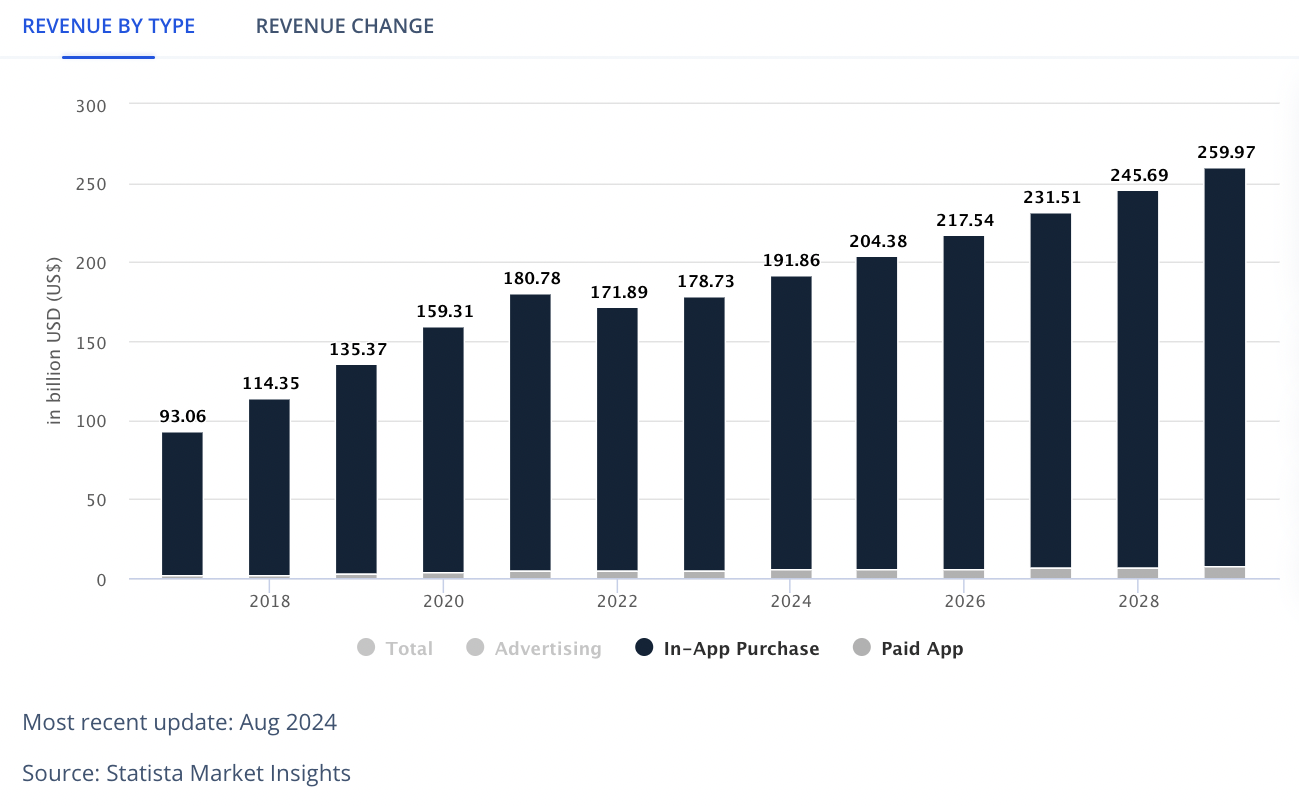
Total In-App Purchase revenues globally. Source: Statista
How much do In-App Purchases make?
In-App Purchases make an average of 0.48 US dollars per user. The average revenue for a paying user is $9.60. The average IAP transaction is $1.08.
The revenues for In-App Purchases vary a lot by business and use case. IAPs can be a major revenue source for businesses.
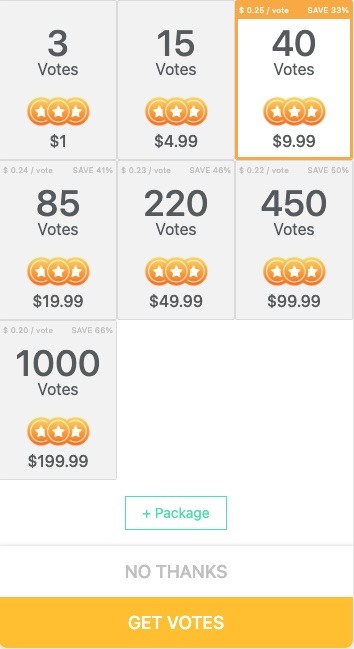
For example large voting contests in live events or TV shows can garner significant sums of money.
In-App Purchases are most notoriously used in gaming apps – IAPs generate more than half of all mobile game revenue.
According to WifiTalents, 65% of developers using In-App Purchases saw an increase in their revenue.
In-App Purchase revenue model
So are In-App Purchases profitable? In short: yes, they can be highly profitable.
There are many factors that affect the profitability:
- The revenue shares with Google and Apple
- Taxes
- Mobile app development costs, maintenance and other running costs of your app
- The popularity and conversion rates of your app
Let’s dig into these aspects.
In-App Purchase revenue shares
Does Apple make money from In-App Purchases?
Yes. On the Apple App Store, Apple charges a 30% fee for apps and In-App Purchases. This fee isn’t applied to free apps.
Apple charges 30% of the first year of a subscription. This then drops to 15% for the following years.
However, if you make less than 1 million US dollars with your app, you're eligible for the App Store Small business program where commissions are reduced to 15% for In-App Purchases and paid apps.
How much money does Google take from in-app purchases?
Google charges a 30 percent cut for purchases through the Google Play Store.
For subscription products, Google charges 15 percent after users have been subscribed for a full year, similarly to Apple.
For customers who make less than 1 million US dollars, Google has a similar program to Apple where you can apply for your fees to get reduced to 15% for your first 1 million USD in sales.
Are In-App Purchases taxed?
Google and Apple handle the required taxes according to local tax laws.
For customers in the UK and EU Member States, the app stores are responsible for charging, collecting, and remitting the VAT on sales according to the EU VAT legislation.
The users will see the tax that will be charged on the checkout screen before completing their purchase. The way the stores calculate and handle tax depends on the type of content.
Purchases are made from the developer of the app.
Overall in most locations, the app developer is responsible for charging taxes according to their local VAT.
As an app developer, you will set tax categories (guides by Apple and Google) for your In-App Purchases when setting them up.
How to calculate your In-App Purchase revenue
Here are the formulas for calculating the gross and net In-App Purchase revenues for your app:
Gross revenue: Total users (in a given timeframe) x Conversion-% to paying customers x Average Purchase per Customer ($) = Gross revenue
Net revenue: Gross revenue * (100% - App Store cut-%) * (100% - Local Value-Added Tax %)
Let's take an example for clarity: let's say there's a voting contest app with a user base of 100 000 in a year. Their conversion-% to paying customer is 3% and the average purchase size per paying customer is $9.00.
This makes the gross revenue $27 000 a year (100 000 * 0.03 * $9).
The company is part of the "small business" programs in both of the app stores, so the stores take only a 15% cut, and the Finnish VAT of 25.5% is applied.
The net revenue is $17 097.75 ($27 000 * (1-0.15) * (1-0.255)).
Use the calculator below to try your own numbers. Its in-app purchase defaults are the example above on a monthly footing — 8,333 users a month is the 100,000 a year, still at 3% and $9.00 — so it lands on about the same $27,000 a year. Those are gross figures: take off the store cut and your local VAT, as above, to reach net. The calculator also estimates what the app costs to build and when it pays back; for the cost side on its own, see the app cost calculator.
Free tool · from Choicely
App cost & revenue calculator
Describe the app you have in mind and see what it would cost to build, what it could earn each month, and how quickly it pays back. No sign-up to see the numbers — change any assumption to fit your case.
Describe the app
Four choices give a build estimate for custom development — and what the same app costs with Choicely.
How complex is it?
Which platforms?
Features beyond the basics (each adds development hours)
If you hired developers, where would they be?
Custom development
—
—
The same app with Choicely
Free to build
Describe it, get a native iOS & Android app in minutes, edit it yourself. 150 credits a month, 25 a day, +100 on signup, no card. Publishing to both stores from $25 a month.
Your audience
Every revenue model below scales from these three numbers.
Time spent in the app: 74,997 minutes a month.
How the app makes money
Switch on every model that applies. Open one to change its assumptions.
The return
Revenue from Step 3 against the two ways of building from Step 1, over one, three and five years.
Build with Choicely
AI builds the native iOS & Android app; you edit it yourself. Free to start; publishing on a paid plan.
Enterprise apps with a managed setup are priced separately — book a demo.
Custom development
From your Step 1 estimate. Year 1 carries the build; later years carry maintenance, updates and improvements.
Adjust the development assumptions
Changing Step 1 resets these to the estimate.
| Year 1 | 3 years | 5 years |
|---|
The comparison assumes both builds reach the same audience and earn the same revenue — the difference is what you pay to get there. Custom development also carries the up-front build before the first user arrives.
This estimate is for an app that doesn't exist yet. Describe it and Choicely builds it — the features and revenue models you chose go into the prompt.
Build app for freeAssumptions are starting points, not promises. Development: build hours by complexity and per-feature hours are Choicely's engineering estimates for a native app on both platforms; regional hourly rates are 2026 mid-level ranges from industry surveys (US & Canada $100–200, Western Europe $60–150, Eastern Europe $40–97, Latin America $35–86, South & SE Asia $20–85 — Appilian, May 2026; Second Talent, Sep 2026), shown here as midpoints and editable. Timeline assumes a team working ~130 productive hours per person per month. Revenue: ad RPM varies widely by format (banners earn far less than rewarded video), install-to-purchase conversion is typically 1–5.5% in the first 30 days, about 2% of non-gaming app users subscribe, and mobile-commerce conversion runs around 1.5–2%. Subscription and loyalty models are shown as a flat monthly figure; over time they compound with retention and churn. Currency changes the symbol only. Prefer a spreadsheet? The same revenue model as a Google Sheet (make a copy to edit).
Calculating the profitability of your app & In-App Purchases
Estimating the profitability of your app is quite straightforward as long as you take all the necessary things into account.
We don’t necessarily recommend to calculate the profitability of In-App Purchases in a silo, but rather estimate the profitability of your app as a whole with all its monetization methods and costs taken into consideration.
For estimating costs, income, profit and ROI, we have developed a Google spreadsheet that you can freely use – just make a copy of it for yourself first.
Estimating incomes, costs and profits with the Sheet:
- On the first tab you can add up revenue estimates for all your monetization methods
- On the second tab you can make cost estimates for two types of app developers (code / no code)
- On the third tab you’ll see profit and ROI breakdowns that are based on the data you filled on the previous two tabs
You can learn more about what goes into estimating the costs of your app in this blog post. Explore different app monetization models here.
Get started with In-App Purchases & Build your app with Choicely
Are you looking to build an app? Do it with Choicely.
Choicely is a No Code App Builder that has been used to create world-class apps for organizations like the Eurovision Song Contest, ITV Studios, Miss Universe and AFTV.
With Choicely, you can build an app in a fraction of the time and cost compared to traditional app development – and have an app running in a matter of mere weeks.
Try our App Makers Quiz to get personalized guides to your app making process, or simply start building your app right away.
And when it comes to In-App Purchases and other monetization methods, we can help.

Build your own app by chatting with AI

Create mobile apps for App Store & Google Play by chatting with Choicely AI
Keep reading, here are some similar posts
How do you make money from a mobile app? Apps earn through several models: in-app purchases and...
Last updated: July 23, 2026 If you have a mobile app, you're probably leaving ad revenue on the table. Not...
Sponsorships are a great way to grow your app. With sponsorships you can fund your app or increase its...